
Podcast Episode #10 - with Trey Dunavant
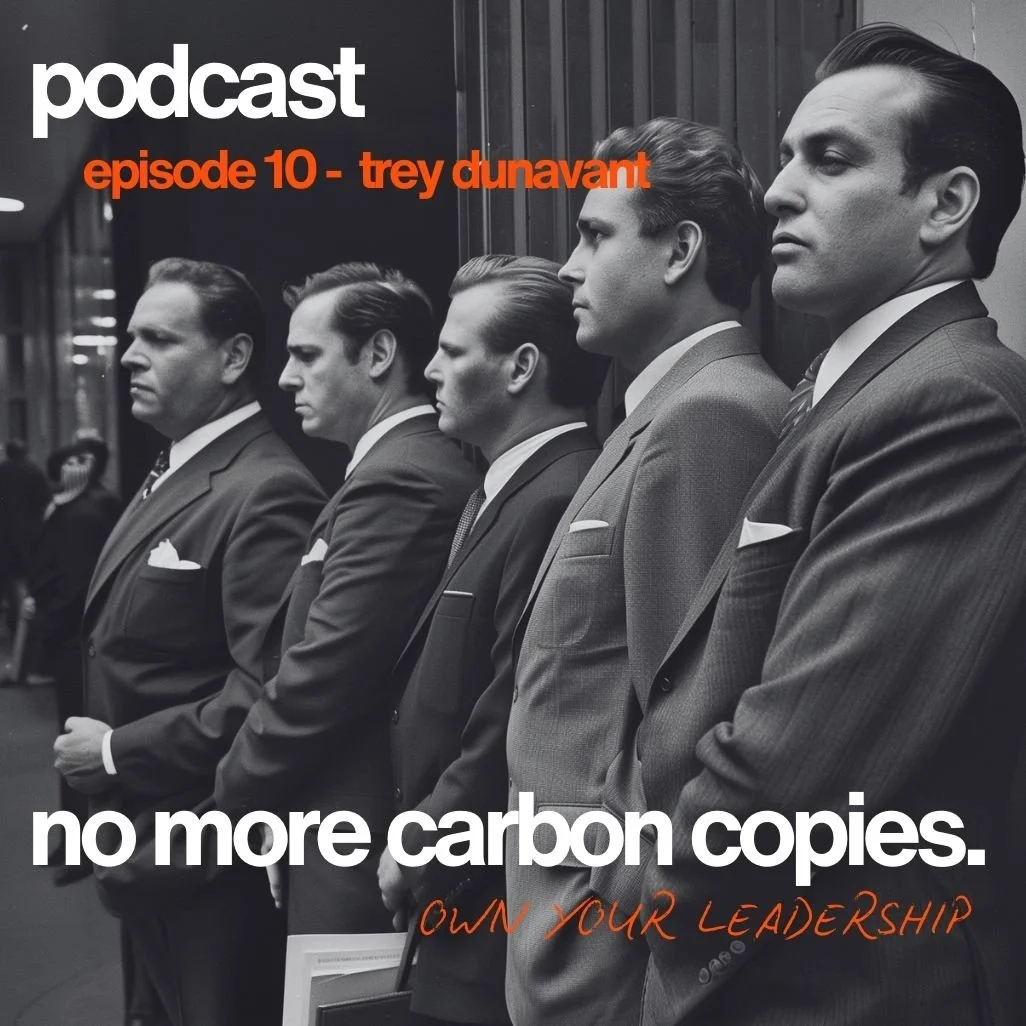
Trey Dunavant
Director of Sales - Belay Solutions
Podcast Transcript: The Power of Self-Awareness in Leadership
Guest: Trey Dunavant, Director of Sales at Belay Solutions
Introduction
Roger: Welcome to the No More Carbon Copies podcast. I’m grateful to have my good friend, Trey Dunavant, with me today. We’re diving into self-awareness—a topic we both believe is essential for leaders and how it affects every aspect of our lives. We’ll discuss why we need it, why we often lack it, how to cultivate it, and the ultimate value it brings to our careers and personal growth.
Trey, thanks for joining us. You’re a frequent guest on other shows, so I appreciate you coming on No More Carbon Copies. Give us a little background on where you are now and your journey to get there.
Trey Dunavant: Absolutely. Currently, I’m the Director of Sales at Belay Solutions. We specialize in virtual staffing—helping leaders nationwide with executive assistants, marketing, and back-office support. My journey has taken many paths, but the "through line" has always been people first, with sales close behind.
Roger: And on the personal side?
Trey Dunavant: I live in Franklin, Tennessee, with my wife of 18 years and our two daughters, ages 10 and 13. If you want a masterclass in self-awareness, I highly recommend having children—they are a great starting point for learning about yourself!
Why Do We Struggle with Self-Awareness?
Roger: Most of us struggle to gain true self-awareness. Why do you think we lose it, or perhaps never develop it in the first place?
Trey Dunavant: It’s an interesting question because self-awareness sounds like a purely inward journey. While knowing yourself is a huge part of it, there’s a missing piece if you don't have people close to you who can speak into your life. Early on, my self-awareness was shallow because I only knew myself as I saw myself.
I’ve also realized that growth isn't linear. You can go through a season feeling like you know yourself well, only to realize there’s an entire "chapter" inside you that hasn't been read or exposed yet. Life experiences have a way of shining a light on those hidden areas.
Roger: I agree. I view it like layers of an onion. You peel one back and think, "Wow, this feels like a totally new thing," but it’s just a deeper layer of who you are. I’ve had seasons where I thought I knew myself, but I was on a "solo mission." I didn’t know what I didn’t know because I wasn’t asking how my presence landed with others.
In college, for example, I felt very insecure and felt like I didn't fit in. Yet, someone told me they found me intimidating and arrogant. It was a complete disconnect between my internal state and my external impact. Have you experienced that dissonance?
Trey Dunavant: Definitely. Someone brings something to you and you think, "Who are they talking about? That isn't me!" We can self-deceive very easily. You can spend all the time you want on solo retreats or journaling—and those are valuable—but they are incomplete without "color commentary" from people you trust.
Roger: Exactly. Without that feedback, you’re flying blind. Inclusion of others is like a "cheat code" for personal growth; it speeds up the journey significantly.
The Danger of the "Blind Spot"
Trey Dunavant: When I lacked self-awareness, I would often self-sabotage. I’d take on tasks I wasn't suited for simply because I didn't understand my own wiring.
Roger: I remember taking a job at 26 because someone I respected invited me into it. I tried to make it work for five years, but it was a terrible fit for my skills and aptitude. I wanted to please others and hit an "aspirational" goal, but it nearly killed me. I had no external feedback to tell me why I was spiraling.
Trey Dunavant: It reminds me of Patrick Lencioni’s "Working Genius." The most dangerous areas aren't the ones we know we’re bad at; they’re the ones in the middle where we think, "I just need to try harder." Without awareness, you just keep pushing until you burn out.
How to Cultivate Self-Awareness
Roger: So, how do we actually get it? What has worked for you?
Trey Dunavant: It’s a mix. First, there’s the solo work—reflection and journaling. Then, there are life experiences that force growth. Finally, there’s the proactive seeking of feedback.
Recently, I did an "emotional audit" with my family. I asked my wife and daughters, "How does Dad show up in this house?" It was incredibly exposing. I don't consider myself an angry person, but their feedback was that I often show up "on edge" or carrying work stress. You have to have the guts to ask those questions.
Roger: That takes real vulnerability. We often stay in "blissful ignorance" because we’re afraid the truth will be disappointing. Even personality tests can be misleading if you take them while you’re feeling insecure or aspirational. They can "lie" to you. But people who care about you will reflect the truth.
Trey Dunavant: I actually went back and interviewed people from my past—even high school and college. It was shocking to see the "through line." Miraculously, people who knew me 20 years ago saw the same unique gifts and blind spots as people I worked with last year.
The Value: Effectiveness and Flourishing
Roger: What is the ultimate value of this work for you?
Trey Dunavant: I wouldn't be in my current role without the work we did in the Leadership Accelerator. It gave me the clarity to know I perform best on a team rather than solo. Now, I leverage that awareness every day. I know when to delegate and when I’m in my "zone of genius." When you’re in that sweet spot, things feel easier and your impact is larger.
Roger: I’ve found that, too. I used to try to be broad and good at everything. Now I realize I’m exponentially more effective in a narrow band. When I stay there, the return on my time is much higher.
Trey Dunavant: There’s an acceptance that has to follow awareness. You have to reckon with the truth and decide to believe it. When you do, the friction disappears. You’re in "flow" more often.
Roger: And as a leader, you have to be even more intentional. The more positional authority you have, the less likely people are to give you honest feedback unless you explicitly invite it. You have to build that trust.
Closing Thoughts
Trey Dunavant: Self-awareness isn't a destination; it’s a journey. It has to be anchored in a calling to serve others. If it’s just about "me," it loses momentum. But when I know myself, I can offer more opportunities to others and let them flourish in their abilities, too.
Roger: A great image for this is a path through the wilderness. We aren't in a ladder-climbing competition; we’re on a journey where we collaborate with others. It’s about a regular discipline of pausing, asking, and reflecting.
Trey, thank you for sharing your wisdom. I’m glad we get to walk this path together.
Trey Dunavant: Thanks for having me, Roger. The work you’re doing is deep and meaningful. Keep it up.